
Power Trowel: The Best Friend of the Concrete Finisher
The power trowel is one of the most important tools in construction. If you’ve ever seen a perfectly smooth concrete floor in a warehouse, a clean garage slab, or a flat industrial surface, you’ve seen what it can do.
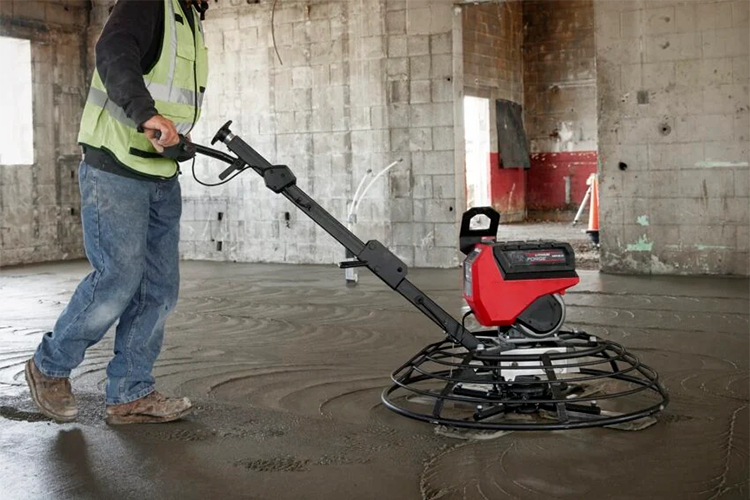
People often call this machine a “helicopter” because its blades spin. It is the key to getting a thick, long-lasting, professional-looking finish on concrete. Let’s look at what makes it so important.
What is a trowel for power?
After the screeding and bull floating stages, a power trowel is a motorized tool used to finish concrete. There is a central engine (gas, electric, or propane) that spins a set of blades or pans at high speed. It smooths, compacts, and brings the finer particles (cream) to the surface as it moves over the concrete, giving it that classic smooth finish.
Why should you use one? The Big Benefits
Better Finish: Gives a flat, dense, and hard surface that can’t be achieved by hand troweling on large slabs.
Efficiency and Speed: It covers huge areas in a fraction of the time it takes to do it by hand, which cuts down on labor costs and project timelines.
More Strength: The compaction process makes the surface denser, which makes it more resistant to wear and tear and lasts longer.
Consistency: Removes human error, making sure that the finish is the same all over the slab.
Choosing the Right Power Trowel for Your Needs
Walk-behind trowels are the most common type. They are great for medium-sized jobs like driveways, floors, and patios. The operators guide them by hand.
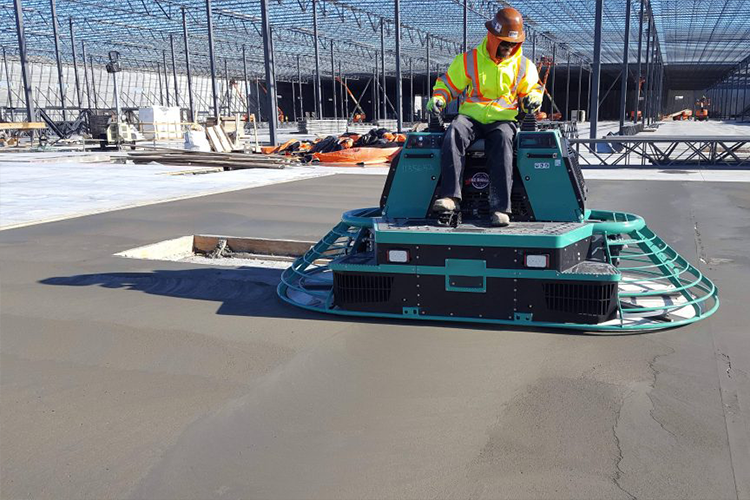
Ride-On Trowels: For very big industrial slabs, like those in warehouses and mega-stores. The operator rides the machine, which lets them cover a lot of ground quickly and with less effort.
Blades vs. Pans: The process usually starts with float blades, which are also called finishing blades. These are slanted to make the concrete flat and tight. To get the final smooth finish, trowel blades (or finishing trowels) are used. These are flat and polished to give the surface a high sheen. Some machines have combination pans that can do both.
How to Get the Most Out of the Technique
Timing is key: If you start too soon on wet concrete, you’ll gouge it. If you start too late, it will be a tough battle against hardening concrete. The “window” is the time when the concrete can hold your weight with only a small dent, like hard plastic. A common rule is that walk-behind trowels can start when the footprint is about 1/4 inch deep.
The Order of Operations: Always finish the concrete in the right order: screed, bull float, power trowel (first with float blades), edge and joint, and finally power trowel (last passes with trowel blades).
Be careful when you work: move in a slow, overlapping circle. With each pass, slowly raise the pitch (angle) of the blade. For the last burnish, use a high speed and a steep blade angle.
Wear safety gear like boots, gloves, and eye protection. Be careful of the spinning blades and always keep the handle straight to stay in control.
Things to think about before buying
When you rent or buy a power trowel, think about:
Project Size: For small areas, use a walk-behind; for large areas, use a ride-on.
The most common blade and pan sizes are between 36 and 48 inches.
Gas engines are powerful and portable, while electric engines are quieter and better for indoor use.
Number of Blades: Models with more than two blades (three or four) usually give a smoother finish.